May
22
Quote of the Week
Filed Under General | Leave a Comment
“Education must prepare students to be independent, self-reliant human beings. But education, at its best, also must help students go beyond their private interests, gain a more integrative view of knowledge, and relate their learning to the realities of life.”
This quote seems extremely relevant in the midst of graduation season.
Feb
25
Ready to Learn
Filed Under General, Ready to Learn | Leave a Comment
Two weeks ago President Obama delivered his State of the Union address to the country. In his speech, he made a point to acknowledge the importance of early education and stated that every American child has the right to enroll in a quality preschool program. President Obama gave three specific reasons as to why focusing on early education is good for the nation in the long run: it will ultimately boost graduation rates, reduce teen pregnancy, and reduce violent crime. During his second term in office, the President explained that he and his staff will look to work with states to ensure that all children start their education career in a respected preschool program.
If you’re aware of the work of Ernest L. Boyer, this may sound familiar. During his career as a lifelong advocate for education, Dr. Boyer had a lot to say about the early years and how critical they are for further development. In a speech entitled “Ready to Learn: A Mandate for the Nation,” he posed a simple question: ”Children are our most precious resource. In the end, they’re all we have. And if we as a nation cannot prepare all children for learning and for life, then just what will bring America together?” With the polarizing nature of American politics today, President Obama could have posed that same question to that nation two weeks ago.
Dr. Boyer’s speech was derived from a special report of the same name published in 1992 by The Carnegie Foundation for the Advancement of Teaching. The report outlined seven initiatives for school readiness. The third priority had to do specifically with preschool education. The Carnegie Foundation stated that every disadvantaged child is entitled to a good head start in a high quality preschool program. In his speech, Dr. Boyer again challenged his audience, asking: “How is it that we [the United States] can spend $300 billion every year on national defense? How is it that we can send space shuttles into orbit? And never seem to have enough money for our children?” The Carnegie Foundation’s report also wanted to recognize the importance of preschool teachers by raising their salaries, hopeful that doing so would also bring them respect.
President Obama perhaps said it best during his State of the Union address: “These initiatives in manufacturing, energy, infrastructure, housing – all these things will help entrepreneurs and small business owners expand and create new jobs. But none of it will matter unless we also equip our citizens with the skills and training to fill those jobs. And that has to start at the earliest possible age.” I think Dr. Boyer would agree.
Feb
8
Miss Rice
Filed Under General | Leave a Comment
Think back to all the teachers you’ve ever had. There may be a couple you are more than happy to forget about, but I’m sure there are a chosen few that rise to the top of the list. If we’re really lucky almost everyone has at least one teacher they could never forget. For me personally, I know I’ll never forget my very first teacher – Mrs. Bentz. Thanks to her, I have very vivid memories of my experience in preschool. Mrs. Bentz ensured that each preschooler felt supported and loved and worthy of her attention. I can still recall the extremely specific feeling of joy after receiving praise from her. I’d say she did her job right if I still have such fond memories of her after all these years, and I think Dr. Boyer would agree.
In fact, Dr. Boyer himself did not shy away from reminiscing about his former teachers. In a number of speaking engagements he recalled a night when he couldn’t fall asleep and instead of counting sheep, decided to count his past teachers. Like most of us, one name in particular towered above them all – Miss Rice, his first grade teacher.
Here’s what Dr. Boyer had to say about his recollections of her:
On the first day of school she said, “Good morning class, today we learn to read.’” Those were the first words I ever heard in school. We spent all day on four words – “I go to school.” We traced them, we sang them, we even prayed them. I ran home that night ten-feet tall, and, announced proudly to my mother, “Today I learned to read.” I doubt I had mastered decoding but I had been taught something much more fundamental. Miss Rice had taught me that language is the centerpiece of learning. Fifty years later, when I got around to trying to write a book called High School, I had a chapter right up front entitled “Literacy: The Essential Tool.” And in our book on College, we have a chapter on the essentialness of language. I say that to pay tribute to an unremembered first-grade teacher – Fairview Avenue Elementary School, Dayton, Ohio, 1930 – who said something of the foundations of formal learning and shakes my thinking to this day. Great teachers live forever.
Miss Rice had no way of knowing that her presence in young Ernie Boyer’s life would be so monumental. Nor could Mrs. Bentz say with certainty that her preschool students would remember her fondly as adults. These two women were simply doing their jobs and being great teachers.
To read more about Dr. Boyer’s experience as a first grader and his thoughts on acknowledging teachers read, “A Celebration of Teaching.”
Jan
28
Quote of the Week
Filed Under General | Leave a Comment
“Wouldn’t it be wonderful if every home has good books instead of knick-knacks and plastic flowers on the bookshelves? And wouldn’t it be great if every child heard good speech and received thoughtful answers to their questions instead of ‘be quiet’ or ‘go to bed’?”
You can read this quote in Dr. Boyer’s speech “Ready to Learn: A Mandate for the Nation.”
Jan
25
Researching From Home
Filed Under General | Leave a Comment
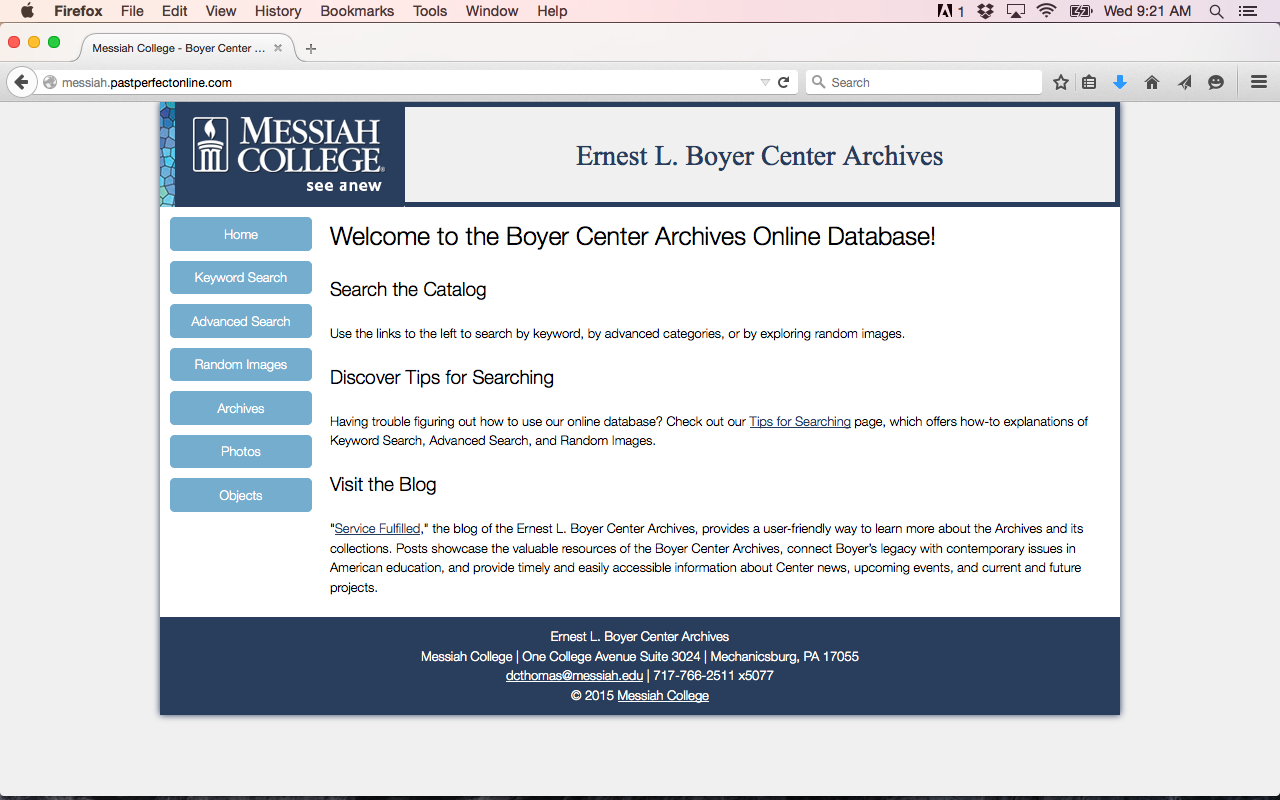
Did you know that you can conduct research on Ernest Boyer from the comfort of your own home? Yes, it’s true! While we love hosting researchers in the archives on campus, we understand that for some people it is not feasible nor altogether necessary to travel to Messiah College. That’s why over the past two years the Ernest L. Boyer Center Archives has made a major push to digitize its collection and make resources more accessible to researchers online. While there is still a lot of work to be done and plenty of materials left to be scanned, major achievements have been made. This post is to help walk you through the steps of researching the work of Ernest Boyer via the web.
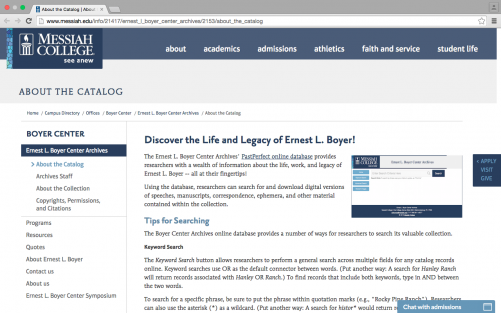
To begin your research go to the Ernest L. Boyer Center Archives homepage. Once there, click on “search the catalog.” Once there, enter relevant search terms or keywords you hope to find in the collection.
The picture to the left is a screenshot of archival record #1000 0000 0038. As you can see, the information available to researchers are as follows: catalog number, object name, the scope and content of the record, the date, the event this record is related to, collection, people, related search terms, and multimedia. For those researching at home, the multimedia field will be the most useful. Our goal is to give researchers the ability to read the exact drafts of speeches, manuscripts, articles, and other resources of that nature on their own computer screens. So, if the PDF version of a document is available to researchers the last field will have a hyperlink, directing you to “click here” (see picture below).
Clicking on the hyperlink will direct you to the PDF version of a speech Dr. Boyer delivered on June 6, 1984, upon receiving the Distinguished Fellow Award of the Academy of Educational Development (AED). You’ll notice that the speech is handwritten, so you can read (or try to read) the words Boyer actually wrote.
So, what are you waiting for? Happy researching!
Jan
21
Today we Americans observe a federal holiday in remembrance of one of the greatest forces for peace and justice that ever lived. Yes, for a lot of people the best thing about today is having a day off work or school. I won’t deny that is a nice perk. I mean, who doesn’t love a three-day weekend? No one. However, amongst the extra errands you may be running to get a head start on the work week, or the extra relaxing you may be enjoying to recuperate from the hectic weekend, we should all carve out a few minutes of our day to remember the life of Martin Luther King, Jr. To remember how he lived so fearlessly for a cause of equality which he pursued tirelessly. To remember the words he spoke so eloquently. To remember that the echoes of his words still ring today. And that some are hearing his words for the first time.
In 1988, Ernest Boyer spoke at a conference sponsored by the Martin Luther King, Jr. Federal Holiday Commission in Washington, D.C. The conference was organized to discuss meaningful ways to infuse the life and work of Martin Luther King, Jr. in school curriculums across the nation. Boyer delivered a speech entitled “The Life of Martin Luther King: An Educational Imperative.”
To Boyer, incorporating the memory of Martin Luther King into the nation’s classrooms was a crucial necessity – and served as a way to expose students to the civil rights movement in the United States, the understanding and power of nonviolence, and reverence for the written and spoken word. Not doing so would mean Martin Luther King, Jr. Day would “be a time when we remember only the symbols, not the substance of his work.”
Boyer’s speech outlined three specific reasons why school curriculums should include a study on Martin Luther King, Jr.:
1.) A study of Dr. King’s life, work, and legacy introduce students to the 20th century freedom movement in the United States.
2.) Dr. King’s legacy lives on today through the words he spoke and penned. He has left the world a multitude of literary devices within his speeches and letters that teachers should tap into and incorporate in lessons. Boyer never stopped triumphing the centrality of language, and for him, Dr. King’s lasting words can teach students that “language is a sacred trust.”
3.) Students that understand Dr. King learn that what you learn in life influences how you live. Education has the power to teach morality. Education has the power to inspire service. Education has the power to fuel mission. The life of Martin Luther King, Jr., better than most, highlights these human imperatives.
In short, Boyer said it quite simply with one sentence in his speech: “No student in America’s schools can be considered well educated if he or she does not learn about this nation’s long and agonizing crusade for civil rights…”
Photo courtesy of The Seattle Times gallery on Martin Luther King Jr. and the civil rights movement.
Jan
19
Chancellor Boyer
Filed Under Higher Education, State University of New York (SUNY) | Leave a Comment
On Monday the country will observe its 57th Presidential Inauguration. In front of a massive crowd in Washington, D.C., and perhaps millions of Americans watching on their television sets, computer screens, or smart phones, Barack Obama will once again take the presidential oath of office and begin his second term as President of the United States of America.
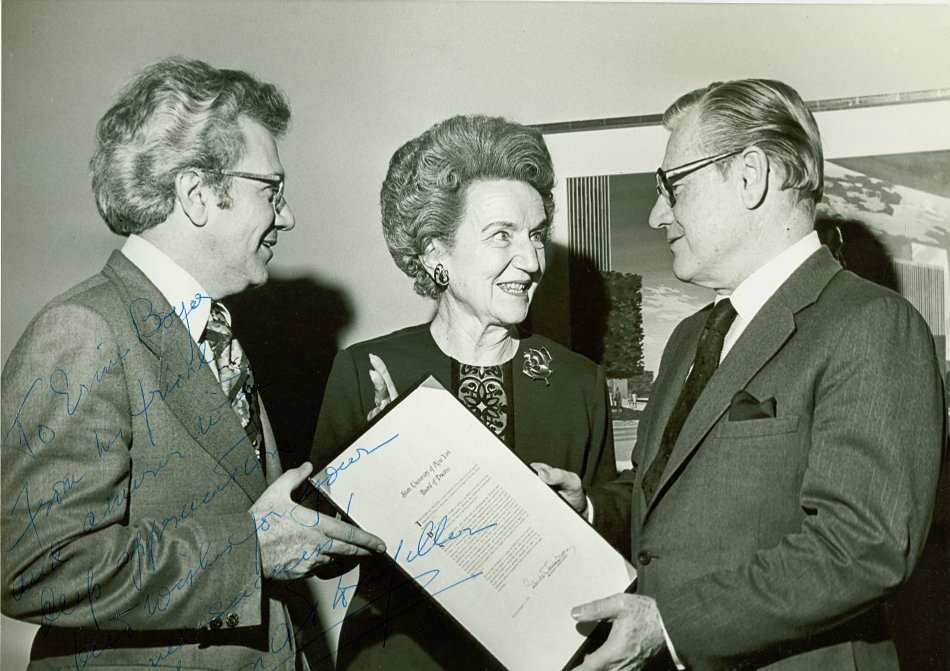
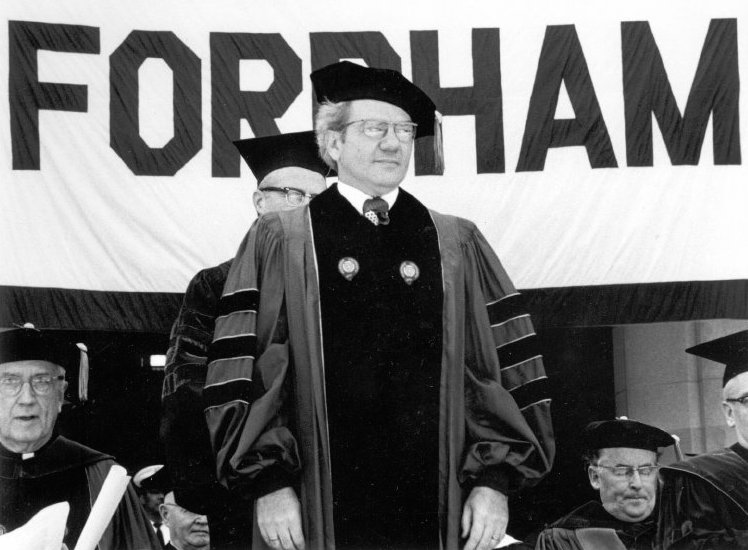
Ernest L. Boyer knew about swearing-in ceremonies too. Maybe not in front of millions of Americans – and people certainly weren’t watching on their smart phones in 1971. But, on April 6, Boyer was inaugurated as the chancellor of the State University of New York (SUNY) in Albany, New York. At the ceremony, Chancellor Boyer delivered a speech entitled “To the Deeper Rituals.” The early ’70s was a time of turmoil for many public institutions of higher education. Aftershocks from the uprising and outcries of the late ’60s could still be felt and Boyer was very much aware of this reality. Instead of shying away, he acknowledged the present challenges head on, claiming: “Campus turmoil of the recent past has ripped our institutional fabric, and we, in the university, enter the decade of the seventies much more sober and mature.” To Chancellor Boyer, however, it did no good to dwell on the sobering realities SUNY faced. Instead, he focused on the solutions. ”I do not for one moment misjudge the urgencies we face. They are very real. And yet, ultimately, the issue is not the gravity of the crisis but rather the quality of the response. The strength, the fiber, of an institution, as in all of us, is not revealed in tranquil, easy times. Rather, character shines through when adversity looms large and hard choices must be made.”
As a college chancellor, Boyer launched new innovations and policies to further the reach of the SUNY system, which boasted 64 separate institutions, 350,000 students, and 15,000 faculty members. One of his most notable accomplishments was establishing the Empire State College – an institution specifically designed to meet the unique needs of adult learners. While chancellor, Boyer also created a bachelor of arts program that could be completed in three years and started the nation’s first student exchange program with the then Soviet Union. Seems like Chancellor Boyer responded quite well – and pretty impressive considering he accomplished all that without a smart phone.
Jan
18
Hockey Anyone?
Filed Under General | Leave a Comment
Anyone excited for the return of hockey tomorrow? Here is Ernest Boyer dropping the puck.
Jan
16
Human Commonalities
Filed Under General | Leave a Comment
Read a few of Ernest Boyer’s speeches and you will begin to notice certain themes. It doesn’t seem to matter what specific topic Boyer was asked to speak on or write about – a few “Boyerisms” always seemed to slip through. One thing I’ve learned since I began working in The Ernest L. Boyer Center Archives two years ago, is that Boyer liked making lists. Like, a lot. Many of his speeches are riddled with sequences and lists. Perhaps he did this for his own organizational purposes? Perhaps he learned it made for clean media sound-bites? Or, perhaps he just had a thing for lists? If so, I can relate, I have a thing for them too.
One of Boyer’s favorite list to incorporate in his speaking engagements was the eight things all humans on this earth have in common. No matter what nationality, tribe, or culture we associate with, we can all relate to these eight universal experiences.
1.) The Life Cycle (all humans experience birth, growth, and death)
2.) Language (all humans use symbols to express their thoughts, feelings, and emotions)
3.) The Arts (various art forms serve as a universal language)
4.) History (all humans, at some point, recall the past and look to the future)
5.) Groups/Institutions (all humans belong in some way)
6.) Work (all humans make a living in some way)
7.) Search for Meaning (all humans, in their own personal way, ponder the larger purpose of life)
8.) The Natural World (all humans are connected to the ecology of the earth)
Read more in “The Human Commanilities: Multiculturalism and Community in Higher Education.”
The photo above is a word cloud created from Boyer’s speech “The Human Commonalities.”
Jan
10
The Man in Action
Filed Under General | Leave a Comment
After spending too much time brainstorming the best way to introduce Ernest L. Boyer to those reading this blog, it finally came to me – why not let him speak for himself?
Over the course of his career, Dr. Boyer had multiple speaking engagements. While heading up the Carnegie Foundation for the Advancement of Teaching he could be scheduled to speak or attend a conference every day of the week. Frequent flier miles; Dr. Boyer had them. The clip above comes from a program entitled “Quest for Peace.” The interview was recorded in 1984, during the start of President Ronald Reagan’s famed “Star Wars” initiative.
Dr. Boyer did not shy away from mentioning the country’s defense strategies while still embroiled in the Cold War, and poses a unique question: Where is the Manhattan Project for peace?